Launch design · 9 min read
The Gated Bonding Curve: Build Before the Open Market
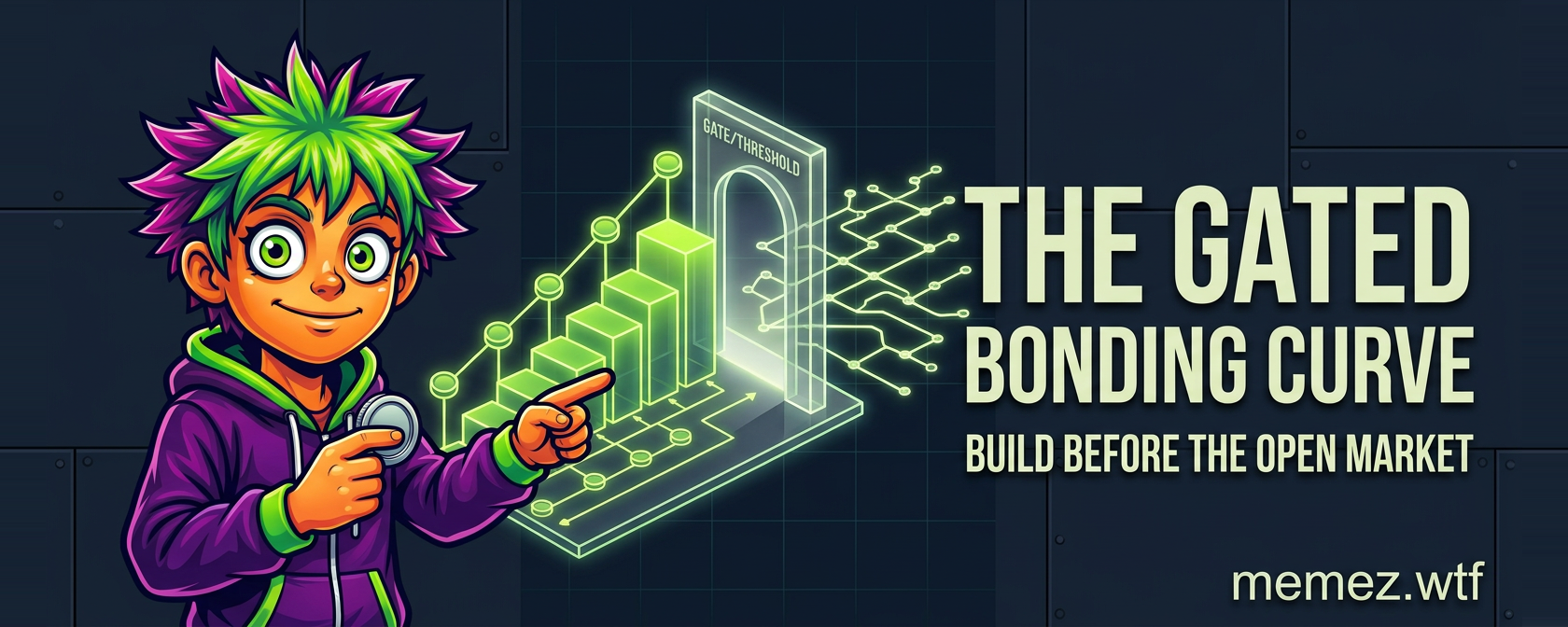
A launch is more than its first candle. Before a token meets the open market, it needs a way to find a price, gather holders and develop a reason for those holders to stay. That is the job of the gated bonding curve.
First, what is a bonding curve?
A bonding curve is a published pricing rule. Instead of waiting for someone to create an exchange pool and quote a price, buyers and sellers trade against the curve itself. Buying moves the price along the curve; selling moves it back. The next price depends on the curve’s current state, not on an order book or a creator’s announcement.
That predictability does not mean a guaranteed fill at the price you first saw. A larger trade changes the price during execution, and rapid trades can move it before yours lands. What the formula gives a launch is a defined mechanism for early price discovery. For the fundamentals, read our bonding curve explainer.
What makes this curve gated?
On Memez.wtf, launching and trading a Memez-launched token while it is on the curve require a signed-in account. Cash Mode is the default way to trade: users see amounts in dollars and can buy or sell through their cash balance. OKX Self-Custody is optional. The gate is about account access to this early market, not a requirement to use a particular wallet mode.
During this phase, the token trades on the Memez.wtf curve rather than in a graduated public DEX pool. Once it graduates, that curve phase ends and the token can trade on the open market. External DEX coins are a separate case: wallet-connected guests may trade those without passing the curve’s account gate.
A gate creates a different opening environment; it does not identify every person behind an account, prevent someone from operating multiple accounts, or eliminate bots, coordinated buying or manipulation. Treat holder counts and activity as signals to inspect, not proof of independent demand.
The launch, step by step
- The creator launches a token. Its base supply is 1 billion tokens. The early trading phase uses the same SOL-anchored curve pricing model across the supported launch chains: the target is expressed in SOL equivalent and converted to the chain’s native currency using a verified SOL price.
- Account holders trade on the curve. Buys and sells move the curve price according to its reserve formula. A visible progress measure shows how close the launch is to its graduation conditions. Market cap is a price-based measure, not the amount of cash available to sellers.
- The launch approaches graduation. The target is 750 million tokens sold and approximately 90 SOL equivalent in net liquidity. The system also accounts for its minimum liquidity threshold and final-sale limits; reaching a headline token count alone is not a promise of instant migration.
- The market opens. Graduation transitions the token to a DEX pool, with a target of roughly 70 SOL equivalent of liquidity seeded in the pool. Its price is then determined by open-market pool trading, not the retired curve. Depth, slippage and third-party market activity matter more than ever.
Why a foundation matters before graduation
Opening a DEX pool makes a token more widely accessible, but accessibility is not the same thing as demand. A launch that reaches the open market with no recognizable community is left to depend on the next chart watcher. The curve phase gives a creator a window to do work that a liquidity event cannot do for them: explain the idea, answer questions, make the token page useful and show up consistently.
It also creates a shared milestone. Participants can see progress toward graduation rather than waiting for an arbitrary listing time. That can help organize communication around a real transition: what has been built, what liquidity will be added and what changes when the token moves to a DEX. A milestone is only useful when the creator is transparent about it.
The strongest foundation is not simply a high holder count. Look for distribution that is not dominated by a handful of addresses, conversations that continue without constant promotion, a creator who responds to difficult questions and reasons to participate beyond a price target. None of that guarantees a healthy market after graduation; it simply gives the launch something more durable than its first spike.
How rewards fit into the story
A creator can choose additional mechanics around a launch, but those should not be confused with the curve itself. For an eligible approved-asset pairing, a creator may set a 1–10% sell tax that buys the paired asset for holder rewards. Those holder drips begin at graduation, then run hourly for eligible holders; they do not drip throughout the pre-graduation curve phase.
Locks, burns, airdrops and other participation tools can help a community express its intentions, but no feature can manufacture conviction. Read the terms of any launch, check who receives rewards and distinguish the token you hold from any asset it may be paired with. A tokenized-stock pairing represents tokenized-stock exposure, not ownership of company equity.
The trade-offs worth being honest about
- Access is narrower before graduation. People who do not want an account cannot trade a Memez-launched curve token in that phase. After graduation, the wider DEX market is a different environment.
- The formula does not remove volatility. Buys can move the curve sharply; sells can reverse that move. Quotes, price impact and fees matter at every stage.
- An account is not a fairness certificate. The gate makes participation account-based, but it cannot guarantee unique humans, equal access, honest creators or protection from losses.
- Graduation changes the risk, not the reality. A DEX pool adds broader access and liquidity, but thin depth, concentrated holdings and abrupt selling can still move the price dramatically.
A practical foundation checklist
If you are launching, use the curve phase to make the next phase understandable rather than merely trying to fill a progress bar.
- Publish the token’s purpose and the creator’s plans in plain language.
- Show the graduation target and explain what changes when open-market trading begins.
- Discuss holder concentration and large wallets instead of hiding them.
- Explain any optional sell tax, paired asset and when rewards actually start.
- Keep communication active through the transition, including setbacks and delays.
- Invite holders to judge the project on evidence, not promises of a certain price.
Build before the doors open
The gated bonding curve is a sequence, not a shortcut: account-based early trading, formula-driven price discovery, measurable progress and a transition to an open DEX market. It creates room to build a foundation before broader trading begins. What a creator does with that room, and how carefully traders assess the result, still determine whether the launch has substance.
For a deeper look at the people side of that work, read Build the Community Before the DEX.